Trueway Financial Services Pvt Ltd is an Indian financial-services company that describes itself as a corporate Direct Selling Agent, commonly known as a DSA. It appears to help individuals, businesses and SMEs explore financing opportunities available through banks, non-banking financial companies and other financial institutions.
Rather than functioning like a traditional bank that directly accepts deposits and independently approves every loan, a DSA usually acts as an intermediary between a borrower and one or more lending institutions. It may assist with product selection, documentation, application submission and communication during the loan process.
This independent trueway financial services pvt ltd guide explains the company’s publicly available information, business model, loan categories, eligibility considerations, documentation requirements, potential benefits and important borrower-safety checks for 2026.
Important editorial disclosure: Truewayfinance.com is an independent financial-information website. It should not be confused with Trueway Financial Services Private Limited or its apparent official website, Truewayfin.com. This article does not claim ownership, partnership, endorsement or official representation of that company.
What Is Trueway Financial Services Pvt Ltd?
Trueway Financial Services Private Limited is a privately held Indian company operating in the financial-services sector. Public company-information sources identify it with Corporate Identification Number, or CIN, U67100DL2020PTC369949.
Available company records indicate that it was incorporated in 2020 and is registered with the Registrar of Companies in Delhi. Third-party corporate records listed the company as active when checked in 2026, although readers should confirm the latest status through the official Ministry of Corporate Affairs database.
The company’s officially presented website describes it as a corporate DSA providing funding support and strategic financial assistance to businesses across India. It says that it works with banks, NBFCs and financial institutions to help clients find suitable borrowing solutions.
Quick Company Overview
| Company detail | Publicly available information |
|---|---|
| Legal name | Trueway Financial Services Private Limited |
| Business sector | Financial services and loan distribution |
| Company type | Private limited company |
| Country | India |
| Incorporation year | 2020 |
| CIN | U67100DL2020PTC369949 |
| Registrar | Registrar of Companies, Delhi |
| Publicly stated role | Corporate DSA and financing intermediary |
| Apparent official website | Truewayfin.com |
| Independent information website | Truewayfinance.com |
Corporate-information websites reported an incorporation date of September 15, 2020, and an active status in early 2026. Because third-party databases may occasionally contain delayed or conflicting information, important company details should always be verified through the Ministry of Corporate Affairs.
Is Trueway Financial Services a Bank?
No, Trueway Financial Services does not publicly describe itself as a bank. It presents itself as a loan-distribution and financial-services company that may connect eligible customers with banks, NBFCs or other financial institutions.
This difference matters because the final lender—not necessarily the DSA—normally controls:
- Credit assessment
- Interest rate
- Approved loan amount
- Repayment period
- Processing charges
- Collateral requirements
- Sanction conditions
- Loan disbursal
- Collection and repayment procedures
A financial intermediary may help prepare or submit an application, but it should not be assumed that the intermediary has authority to guarantee approval.
What Does DSA Mean?
DSA stands for Direct Selling Agent. In lending, a DSA typically promotes financial products and refers suitable applications to a bank or NBFC.
A DSA may perform functions such as:
- Identifying a customer’s financing requirement
- Explaining available lending categories
- Conducting an initial eligibility discussion
- Providing a document checklist
- Collecting application information with permission
- Forwarding an application to a partner lender
- Coordinating communication between borrower and lender
- Following up on the application’s progress
The Reserve Bank of India requires regulated financial institutions to ensure that their agents handle customers carefully, protect private information and communicate product terms correctly. RBI guidance also states that banks and NBFCs remain responsible for appropriate conduct by their agents. Read RBI’s DSA and outsourcing guidance.
How Trueway Financial Services Pvt Ltd Appears to Work
The company appears to follow a loan-distribution model. A potential borrower shares a financing requirement, and the company may help identify a lender whose criteria could match the borrower’s profile.
A typical DSA-assisted financing process contains the following stages.
1. Initial Requirement Assessment
The process normally begins with a discussion about the applicant’s financing needs.
For an individual, this might include the required amount, income, employment type, existing debts and intended purpose. A business may need to provide information about turnover, operational history, profitability, cash flow and the intended use of funds.
At this stage, the customer should ask whether the conversation is only an initial enquiry or whether a formal credit application is being created.
2. Preliminary Eligibility Review
The DSA may conduct an initial review to determine which lender criteria the applicant might satisfy.
This review does not represent final approval. The actual lender normally conducts its own credit assessment and may request additional documents.
Common eligibility factors include:
- Applicant’s legal age and capacity to enter a contract
- Monthly or annual income
- Business turnover
- Employment or business stability
- Credit history
- Existing loan obligations
- Debt-to-income ratio
- Property value for secured financing
- Requested amount and repayment period
The company website lists example eligibility requirements, but these should be treated as indicative. Every bank or NBFC can apply different underwriting rules.
3. Document Collection
Applicants may be asked to provide identification, address, income or business documents.
The exact requirements depend on the product and lender. A business loan usually requires more detailed financial records than a small personal loan.
Before providing documents, confirm:
- The legal name of the receiving company
- Why each document is required
- How the information will be stored
- Whether it will be shared with multiple lenders
- How to withdraw consent where legally permitted
- Who should be contacted if information is misused
Sensitive documents should never be sent to an unidentified person, personal social-media account or unverified mobile application.
4. Lender Matching and Application Submission
After reviewing the applicant’s information, a DSA may select one or more lending partners whose general criteria appear suitable.
The borrower should ask for the lender’s complete legal name before the application is submitted. Applicants should also understand whether their details will be sent to one lender or several lenders.
Submitting applications to multiple institutions can potentially result in several credit enquiries. Therefore, the borrower should provide informed consent before the information is distributed.
5. Credit Assessment by the Lender
The bank or NBFC may verify documents, examine the credit report and assess the applicant’s ability to repay.
For business financing, the lender may also examine:
- GST filings
- Income-tax returns
- Bank-account activity
- Profit-and-loss statements
- Balance sheets
- Cash-flow stability
- Existing liabilities
- Business vintage
- Industry-related risks
For a loan against property, the lender may conduct legal and technical checks on the property.
6. Sanction Letter and Final Offer
If the application is accepted, the lender may issue a sanction letter containing proposed terms.
A sanction letter should be reviewed carefully. It may include:
- Approved loan amount
- Interest-rate type
- Annual percentage rate or total borrowing cost
- Repayment period
- EMI amount
- Processing charges
- Insurance charges
- Collateral details
- Late-payment consequences
- Foreclosure conditions
- Offer-validity period
- Conditions required before disbursal
Approval should not be accepted based only on a phone call or WhatsApp message. The borrower should obtain official documentation from the lender.
7. Disbursal and Repayment
After the borrower accepts the final agreement and satisfies the lender’s conditions, funds may be disbursed to the approved bank account.
The company website advertises relatively fast processing, but actual approval and disbursal times depend on document verification, credit assessment, lender policy and the complexity of the case. No responsible intermediary can guarantee a specific disbursal time for every applicant.
Repayments should be made only through the method provided in the official lender agreement.
Financial Products Associated With Trueway Financial Services
The company’s public website highlights several types of funding solutions. Availability, amount, pricing and approval remain subject to the final lender.
Unsecured Business Loans
An unsecured business loan does not normally require the borrower to pledge a specific property as collateral. Eligibility is usually based on the financial strength of the business and its owners.
A lender may consider:
- Annual turnover
- Business age
- Profitability
- Bank transactions
- GST returns
- Tax filings
- Credit history
- Existing financial obligations
Because the lender does not have specific collateral securing the loan, unsecured borrowing may carry a higher interest rate than comparable secured financing.
It can be used for legitimate business purposes such as purchasing inventory, expanding operations, managing working capital or upgrading equipment. Borrowers should avoid taking a larger loan simply because a higher amount is offered.
Loan Against Property
A loan against property is a secured loan in which an eligible property is offered as collateral.
It may provide access to a larger amount or longer repayment period than an unsecured loan. However, it also creates serious collateral risk. Failure to meet repayment obligations can lead to enforcement action against the secured property according to the agreement and applicable law.
Before accepting a loan against property, review:
- Property valuation
- Approved loan-to-value ratio
- Fixed or floating interest rate
- Processing and legal fees
- Repayment period
- EMI amount
- Foreclosure terms
- Default consequences
- Insurance requirements
Applicants should consider independent legal or financial advice before pledging an important residential or commercial property.
SME Loans
SME loans are intended to support small and medium-sized enterprises. The financing structure can vary considerably depending on the business, lender and purpose.
Possible SME-financing needs include:
- Working capital
- Business expansion
- Machinery purchases
- Commercial vehicles
- Inventory procurement
- Office or shop renovation
- Technology upgrades
- Short-term cash-flow gaps
A business should compare the expected benefit of the investment with the total repayment cost. Borrowing to expand operations can be useful only when projected cash flow is strong enough to support regular payments.
Personal Loans
Although the company’s main positioning emphasizes business funding, its public eligibility information also references personal loans.
A personal loan is generally unsecured and may be considered for legitimate planned or emergency expenses. It should not be used without a repayment plan.
Approval can depend on employment, income, credit history, existing EMIs and lender policy. Financial contracts are generally available only to adults who meet the applicable legal-age and lender requirements.
Documents That May Be Required
Documentation varies by product, but the company website lists examples covering identity, income and business verification.
Identity and Address Documents
A lender may request:
- PAN card
- Aadhaar card
- Passport
- Voter identification
- Address proof
- Recent photograph
Only provide documents through a verified channel associated with the company or final lender.
Income Documents
Salaried applicants may be asked for:
- Recent salary slips
- Bank statements
- Form 16
- Income-tax returns
- Employment verification
Self-employed applicants may need:
- Income-tax returns
- Business bank statements
- Financial statements
- Proof of business registration
- GST records where applicable
Business Documents
Depending on the business structure, requirements may include:
- GST registration
- Certificate of incorporation
- Partnership deed
- Memorandum and Articles of Association
- Balance sheet
- Profit-and-loss statement
- Bank statements
- Business-address proof
- Ownership details
Submission of documents does not guarantee approval. It enables the lender to conduct an assessment.
Benefits of Using a Financial DSA
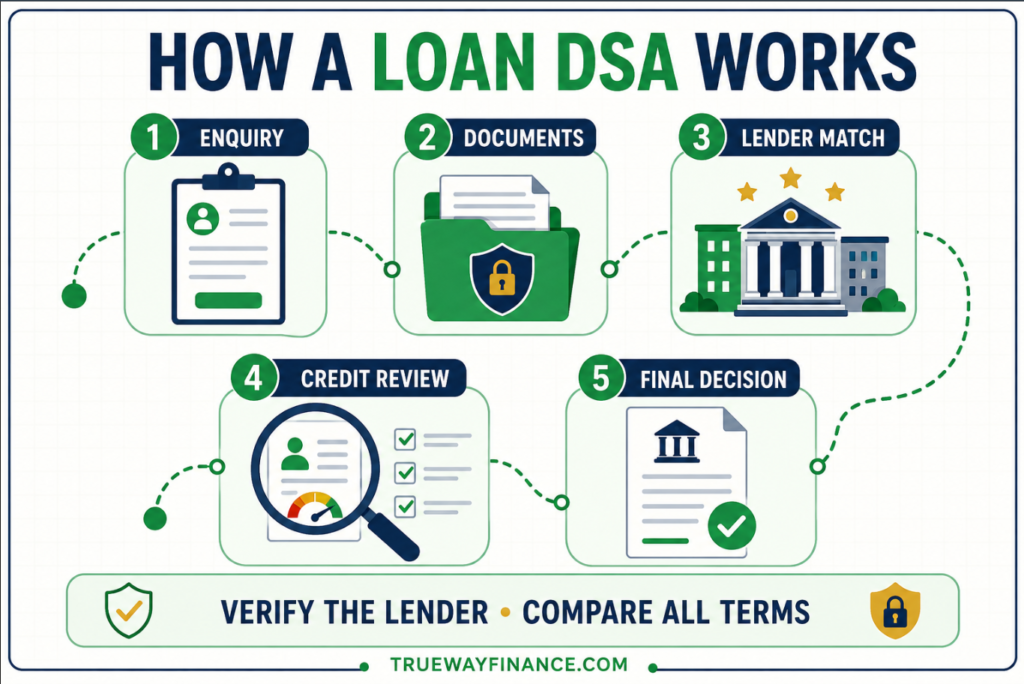
A professional DSA can make loan research and coordination easier, particularly for business owners who do not know which lender may suit their situation.
Potential benefits include:
Access to Multiple Lending Relationships
A DSA may work with several banks and NBFCs. This could help an applicant identify lenders whose products match the requested amount, business type or financial profile.
However, customers should confirm how many offers are genuinely being compared.
Documentation Support
Business-loan documentation can be complex. An intermediary may help the applicant understand which records are required and identify missing information before submission.
The applicant remains responsible for ensuring that all information is accurate.
Application Coordination
A DSA may communicate with the lender, track progress and help respond to routine document requests. This can save time for business owners managing multiple responsibilities.
Product Awareness
A borrower may initially consider an unsecured loan when a different product could offer more appropriate terms. A knowledgeable representative can explain broad product differences.
The final decision should still be based on written lender disclosures, not verbal assurances.
Limitations and Risks to Consider
Using an intermediary does not remove the risks associated with borrowing.
The DSA Does Not Control Final Approval
A representative may believe that an application has a good chance of succeeding, but the lender makes the final decision.
Treat claims such as “100% approval,” “guaranteed sanction” or “loan without verification” as warning signs.
Interest Rates Can Vary
The final interest rate may depend on credit history, income, business performance, collateral and lender policy.
An advertised starting rate may apply only to highly qualified applicants. Compare the final annual cost rather than relying on promotional wording.
Fees May Apply
Possible charges include:
- Processing fees
- Documentation charges
- Legal-verification costs
- Property-valuation fees
- Insurance premiums
- Stamp duty
- Foreclosure charges
- Late-payment penalties
Ask which fees go to the lender and whether any separate intermediary fee is payable. Never transfer an unexplained “approval fee” to a personal bank account.
Personal Information May Be Shared
A DSA may need to send information to lending partners. Read the privacy and consent statements before submitting identity, financial or contact details.
Ask whether your data will be used for marketing or shared beyond the lenders relevant to your application.
How to Verify Trueway Financial Services Pvt Ltd
Consumers should independently verify any financial company before sharing confidential information.
Check Corporate Registration
Search the company name or CIN through the Ministry of Corporate Affairs company-information service.
Confirm:
- Exact legal name
- CIN
- Current status
- Registered address
- Incorporation date
- Directors
- Filing information
Public corporate-information sources listed the company as active in 2026, but official MCA data should be treated as the authoritative source.
Confirm the Official Website and Contact Details
The apparent company website is Truewayfin.com, while Truewayfinance.com is an independent educational website.
Because similar domain names can cause confusion, verify:
- Domain spelling
- Official email address
- Office telephone number
- Company address
- Name of the representative
- Legal entity receiving documents
Verify the Final Lender
A DSA’s company registration does not establish that it is itself a bank or RBI-registered NBFC.
Ask for the full name of the bank or NBFC that will provide the loan. Then verify that institution through its official website and appropriate RBI resources.
The RBI advises consumers to verify the background of companies offering online loans and avoid sharing KYC documents with unidentified people or unauthorized applications. Review RBI’s digital-lending safety guidance.
Obtain a Key Fact Statement
The borrower should request a clear statement containing the important loan terms, including:
- Loan amount
- Interest rate
- Annual borrowing cost
- Repayment term
- EMI
- Processing charges
- Late-payment charges
- Collateral
- Foreclosure conditions
- Total repayment amount
RBI rules require regulated lenders to provide borrowers with key information about covered loans in a clear format.
Common Mistakes to Avoid
Applicants can reduce financial and privacy risks by avoiding these mistakes:
- Believing verbal approval is final
- Signing blank application forms
- Hiding existing debts
- Providing incorrect income information
- Paying money to a personal account
- Sharing OTPs or banking passwords
- Uploading KYC documents to an unverified app
- Ignoring the total repayment amount
- Comparing only the EMI
- Applying through too many lenders simultaneously
- Pledging property without understanding the risk
- Accepting insurance or add-on services without reviewing them
- Failing to keep copies of submitted documents
A smaller EMI does not automatically mean a cheaper loan. A longer tenure can reduce the monthly payment while increasing the total interest paid.
Trueway Financial Services vs Truewayfinance.com
These names should not be treated as the same organization without documented evidence.
| Name | Apparent purpose |
|---|---|
| Trueway Financial Services Private Limited | Indian financial-services and loan-distribution company |
| Truewayfin.com | Apparent company website |
| Truewayfinance.com | Independent finance-information and educational website |
Readers visiting trueway financial services content on Truewayfinance.com should understand that the website publishes independent financial guides. It does not automatically represent the Indian private limited company discussed in this article.
This distinction improves transparency and prevents readers from sending confidential financial documents to the wrong website.
Conclusion
Trueway Financial Services Pvt Ltd appears to operate as an Indian financial-services and corporate DSA company. Its publicly stated business model involves helping consumers and businesses explore funding through banks, NBFCs and other lending institutions.
Potential services include unsecured business finance, loans against property, SME funding and assistance with certain personal-loan enquiries. The company may support customers with initial eligibility discussions, document preparation, lender matching and application coordination.
However, a DSA is not the same as the final lender. Interest rates, fees, approval amounts, repayment terms and disbursal decisions normally remain under the control of the bank or NBFC providing the loan.
Before proceeding, verify the company through MCA records, confirm the representative’s identity, identify the actual lender, review the Key Fact Statement and avoid paying unexplained charges. Sensitive documents should only be submitted through verified and secure channels.
For independent financial education and company overviews, readers can visit Truewayfinance.com. The website provides general information and should not be interpreted as the official website of Trueway Financial Services Private Limited.
Frequently Asked Questions
Is Trueway Financial Services Pvt Ltd a bank?
No. The company publicly presents itself as a financial-services and corporate DSA business. It may help connect applicants with banks or NBFCs, but the final lender normally controls approval and loan terms.
What is the official website of Trueway Financial Services?
The company’s apparent official website is Truewayfin.com. Truewayfinance.com is a separate, independent financial-information website and should not be confused with the company’s official platform.
What services does Trueway Financial Services provide?
Its public website highlights business loans, loans against property, SME funding and broader financial assistance. Availability and eligibility depend on the lending institution handling the application.
Does Trueway Financial Services guarantee loan approval?
No applicant should assume guaranteed approval. The final decision depends on the bank or NBFC, the applicant’s credit profile, income, documentation, existing obligations and applicable lending rules.
How can I verify Trueway Financial Services Pvt Ltd?
Check its company name and CIN—U67100DL2020PTC369949—through the Ministry of Corporate Affairs. You should also confirm its official contact details and verify the final lending institution before submitting documents or making any payment.
Financial disclaimer: This article is for general educational purposes only. It is not financial, legal, investment, credit or tax advice. Product availability, eligibility, costs and terms may change. Always verify current information with the relevant company and regulated lender.