TraceLoans is a financial information website that publishes educational content about loans, credit, debt management, and borrowing. As of July 2026, its publicly accessible pages appear to work primarily as educational resources rather than clearly presenting TraceLoans as a bank or direct lender.
This independent guide from True Way Finance explains what TraceLoans is, the type of information users may find on traceloans.com, and how Americans can safely research debt consolidation, mortgage loans, and bad-credit options.
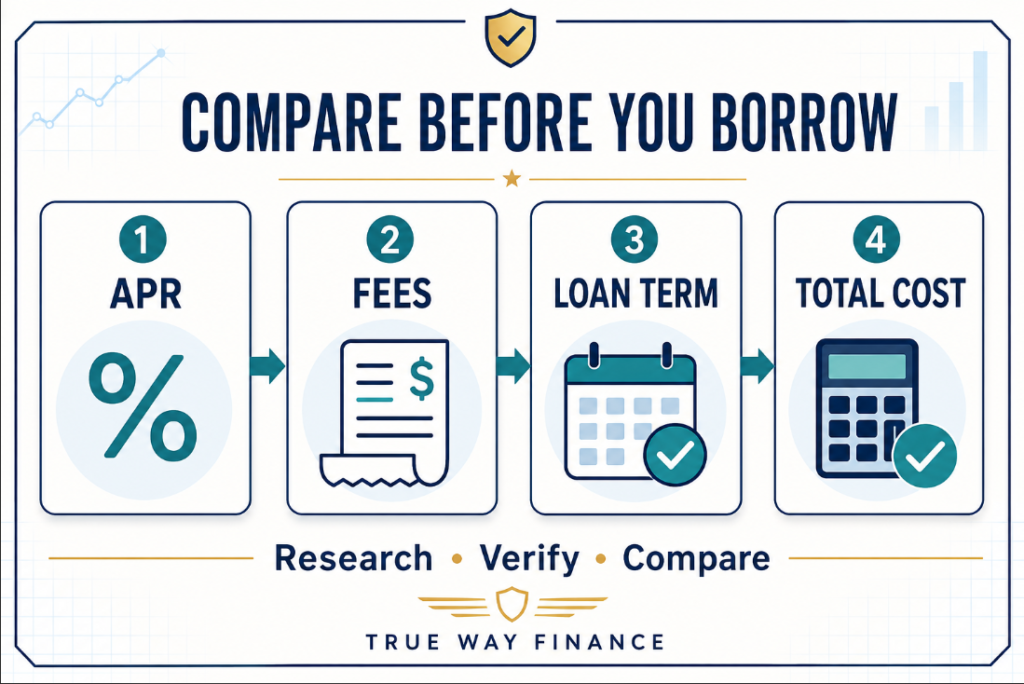
We will also explain how to compare annual percentage rates, repayment terms, origination fees, monthly payments, and lender credentials before submitting a loan application.
Editorial disclosure: True Way Finance does not claim to own, operate, or represent TraceLoans. This article is an independent educational overview, not a loan offer, approval guarantee, or personal financial recommendation.
What Is TraceLoans?
TraceLoans appears to be an online financial education and loan-information website. It publishes articles intended to help readers understand borrowing, repayment, unsecured personal loans, debt management, credit reports, and consumer finance trends.
The publicly visible TraceLoantraceloanss website includes content categories such as Debt Management, Personal and Consumer Loans, and Unsecured Personal Loans. However, its accessible homepage does not clearly establish that the website directly originates, underwrites, funds, or services loans.
That distinction is important.
A financial information website explains financial products. A direct lender evaluates applications, determines eligibility, issues loan agreements, and provides funds. A loan marketplace or broker may collect information and connect applicants with third-party lenders.
USA consumers should not assume that an educational article represents an available loan product. Before entering personal information, determine which company would actually receive the application and whether it is licensed to conduct business in your state.
TraceLoans at a Glance
| Feature | What USA readers should understand |
|---|---|
| Financial articles | The website publishes content about loans, debt, and credit |
| Direct lending | Not clearly established by the publicly accessible homepage |
| Guaranteed approval | Consumers should never assume approval is guaranteed |
| Rates and fees | Actual terms must come from the lender’s official disclosures |
| Mortgage licensing | Verify the lender or broker through NMLS Consumer Access |
| Credit decisions | Normally depend on income, credit, debt, state, and lender rules |
Why Are People Searching for TraceLoans in 2026?
Many people search for TraceLoans because they want clear information about borrowing without immediately visiting several banks or lenders. Common searches relate to consolidating debt, financing a house, obtaining a personal loan, or understanding loan options for a low credit score.
Financial websites can help consumers learn the vocabulary used in lending. For example, a reader may want to understand the difference between an interest rate and APR before comparing offers.
According to the Consumer Financial Protection Bureau, an interest rate represents the cost of borrowing the principal, while APR generally includes the interest rate and certain additional lender charges. That makes APR particularly useful when comparing similar offers. The CFPB explains the distinction here.
People may research TraceLoans for several reasons:
- To learn how personal loans work
- To understand debt consolidation
- To research mortgage terminology
- To explore borrowing with imperfect credit
- To compare secured and unsecured loans
- To identify common lender fees
- To learn how repayment periods affect total cost
- To recognize warning signs of loan scams
The information can be a starting point, but it should not replace an official loan agreement, licensed financial professional, housing counselor, or nonprofit credit counselor.
How Does TraceLoans Work?
TraceLoans appears to work mainly by organizing financial articles around common borrowing questions. A reader searches for a subject, reviews the relevant guide, and then uses that information to evaluate potential financial products elsewhere.
A sensible research process would look like this:
- Identify the type of financing you are researching.
- Read an educational guide to understand the product.
- Calculate how much you actually need.
- Compare offers from banks, credit unions, or licensed online lenders.
- Review APR, fees, repayment terms, and monthly payments.
- Verify the lender before sharing sensitive information.
- Read the final agreement before accepting an offer.
Reading an article is not the same as applying for credit. Likewise, seeing an estimated rate in an advertisement does not mean every applicant will qualify for it.
Eligibility commonly depends on factors such as credit history, verified income, existing debt, requested loan amount, repayment term, state of residence, and the lender’s underwriting standards.
Understanding TraceLoans.com Debt Consolidation
The search term traceloans.com debt consolidation generally reflects an interest in combining multiple debts into one new account. Debt consolidation may simplify repayment, but it does not automatically reduce the total cost of debt.
The CFPB defines a debt consolidation loan as money borrowed to repay separate debts, leaving the borrower with one new amount to repay over time. The new loan might carry a lower interest rate, but the result depends on the offer and the borrower’s financial profile. Read the CFPB’s debt-consolidation explanation.
How Debt Consolidation Works
Suppose a consumer has balances on three credit cards and one personal loan. Each account may have a different due date, interest rate, and minimum payment.
With consolidation, the consumer may obtain one personal loan and use its proceeds to pay the existing accounts. Instead of managing four payments, the borrower repays the new loan according to its agreement.
This can provide:
- One regular monthly payment
- A fixed repayment schedule
- A predictable payoff date
- Potentially lower interest costs
- Easier payment management
However, consolidation is useful only when the new terms are genuinely better or make repayment more manageable.
What to Compare Before Consolidating Debt
Do not compare monthly payments alone. A lower payment can result from a longer term, and a longer term can increase the total interest paid.
Compare these details:
- Current outstanding balances
- Current APRs
- Existing monthly payments
- Proposed consolidation-loan APR
- Origination or processing fee
- Amount deposited after fees
- Length of the repayment term
- New monthly payment
- Total of all scheduled payments
- Prepayment penalty, if applicable
- Late-payment charges
- Whether the rate is fixed or variable
For example, extending repayment from three years to seven years may make the monthly bill smaller. Nevertheless, the borrower might remain in debt longer and pay more interest overall.
Consolidation Is Not the Same as Debt Settlement
Debt consolidation involves repaying existing debts with a new loan. Debt settlement usually involves attempting to negotiate payment of less than the full amount owed.
The two approaches carry different costs and risks. Settlement can affect credit, create collection problems, and potentially involve tax consequences. Consumers should not confuse a consolidation loan with a debt-settlement program.
A nonprofit credit counselor may also offer a debt-management plan. That is different from taking out a new loan because the counselor may coordinate repayment with existing creditors instead of replacing those debts with new financing.
Understanding TraceLoans.com Mortgage Loans
People searching for traceloans.com mortgage loans are usually looking for information about buying a home, refinancing an existing mortgage, or comparing home-loan terms.
A mortgage is a long-term loan secured by real property. Because the home acts as collateral, failure to meet the agreement can have serious consequences. Consumers should base decisions on official lender documents—not on an article, advertisement, calculator, or promotional rate.
Important Mortgage Terms to Understand
Before comparing mortgage options, learn these basic terms:
- Principal: The amount borrowed to purchase or refinance the property.
- Interest rate: The percentage charged for borrowing the principal.
- APR: A broader measure that includes the interest rate and certain loan costs.
- Loan term: The scheduled repayment period, such as 15 or 30 years.
- Fixed-rate mortgage: A loan whose interest rate generally remains unchanged.
- Adjustable-rate mortgage: A loan whose rate may change according to its terms.
- Points: Upfront charges that may affect the mortgage rate.
- Closing costs: Fees associated with completing the transaction.
- Private mortgage insurance: Coverage that may be required in certain situations.
- Cash to close: The estimated amount the borrower must provide at closing.
Compare Official Loan Estimates
The Consumer Financial Protection Bureau recommends requesting and reviewing Loan Estimates from multiple lenders. The standardized document allows borrowers to compare important details, including estimated payments, closing costs, interest rates, and cash needed at closing. Use the CFPB Loan Estimate explainer.
When comparing Loan Estimates, make sure each offer uses a similar:
- Loan amount
- Mortgage type
- Repayment period
- Down payment
- Rate-lock period
- Property and occupancy information
Comparing a 15-year fixed mortgage with a 30-year adjustable mortgage will not provide an equal comparison. The payment, rate risk, and total cost can be significantly different.
Prequalification Does Not Guarantee Final Approval
A mortgage prequalification or preapproval can help a buyer understand an estimated budget, but it is not the final loan approval.
The lender may still need to verify:
- Income and employment
- Credit reports
- Existing monthly debts
- Bank statements and assets
- Property value
- Homeowners insurance
- Title information
- Source of down-payment funds
Avoid making major financial changes while a mortgage is being reviewed. Opening new credit accounts, financing a vehicle, changing employment, or increasing credit-card balances can affect the application.
Verify a Mortgage Professional
USA borrowers can use NMLS Consumer Access to check whether a mortgage company or professional is authorized to conduct business in their state. The CFPB identifies NMLS Consumer Access as a free verification resource for consumers.
A genuine lender should be willing to provide its legal business name, contact details, applicable NMLS number, and required disclosures.
Understanding TraceLoans.com Bad Credit
The phrase traceloans.com bad credit is often searched by consumers who are concerned that past late payments, high credit utilization, collections, or a limited credit history may affect their eligibility.
Bad credit does not describe one universal score or borrowing outcome. Each lender uses its own criteria, and approval may depend on more than a credit score.
A lender might consider:
- Payment history
- Verified income
- Employment stability
- Debt-to-income ratio
- Recent credit inquiries
- Open and closed accounts
- Loan amount requested
- Collateral, if applicable
- State lending requirements
Can Someone Get a Loan With Bad Credit?
Some lenders consider applications from people with imperfect credit, but approval is never automatic. Available offers may have higher APRs, lower loan limits, additional fees, or shorter repayment periods.
No responsible website should be interpreted as promising guaranteed approval regardless of credit history.
The Federal Trade Commission warns consumers about advance-fee loan scams in which someone promises access to credit regardless of credit history but requires payment before providing the supposed loan. The FTC advises consumers not to pay upfront for a promised loan.
Safer Steps Before Applying
Before considering a bad-credit loan:
- Review your credit reports for inaccurate information.
- Calculate the exact amount you need.
- Decide what monthly payment is realistically affordable.
- Check whether prequalification uses a soft or hard credit inquiry.
- Compare APRs rather than advertised interest rates alone.
- Investigate the lender’s legal identity and state authorization.
- Read the privacy policy before entering personal information.
- Reject any request for an upfront payment through gift cards, cryptocurrency, or wire transfer.
USA consumers can request credit reports through AnnualCreditReport.com, the federally authorized source referenced by US government consumer resources.
Alternatives to High-Cost Bad-Credit Loans
Before accepting an expensive offer, consider whether another solution is available:
- A small-dollar loan from a credit union
- A structured payment plan with the original creditor
- A nonprofit credit-counseling program
- An employer-based emergency assistance program
- A secured loan with clearly understood collateral risk
- A lower-cost loan with a qualified co-borrower
- Delaying a nonessential purchase while building savings
A co-borrower or cosigner becomes legally responsible according to the agreement. This option should not be treated as a simple way to improve approval chances without considering the obligation placed on the other person.
How to Evaluate Any Loan Mentioned Online
Online loan research becomes safer when consumers use a consistent comparison method. The name of the website matters less than the legal company providing the credit and the written terms offered to the borrower.
1. Confirm the Company’s Role
Find out whether the business is:
- A direct lender
- A loan broker
- A lead-generation company
- A financial marketplace
- An advertising partner
- An educational publisher
If a website passes information to third parties, check how many companies may receive it and whether those companies can contact you.
2. Identify the Actual Lender
The final offer should identify the lender’s legal business name and contact information. For mortgage products, look for the NMLS identification details.
Do not rely only on a brand name, logo, testimonial, or domain name.
3. Review APR and Total Cost
APR is generally more useful than the interest rate alone because it incorporates certain additional charges. Two loans with the same stated interest rate may have different APRs due to origination fees or other costs.
Review:
- Amount borrowed
- Amount actually received
- APR
- Finance charge
- Number of payments
- Payment amount
- Total of payments
- Late charges
- Prepayment conditions
4. Understand the Credit Inquiry
Prequalification may involve a soft inquiry, which generally does not affect a credit score. A formal application may involve a hard inquiry.
Do not assume an inquiry is soft simply because a website says “check your rate.” Read the disclosure presented before submitting the form.
5. Protect Personal Information
Only provide sensitive information when you understand who is collecting it and why.
Look for:
- A secure HTTPS connection
- A readable privacy policy
- A physical or verifiable business address
- Working customer-support details
- Clear consent language
- An explanation of third-party data sharing
A padlock icon indicates that data is encrypted in transit, but it does not prove that a business is reputable or licensed.
Is TraceLoans Legit in 2026?
TraceLoans has an active website containing financial articles, but that fact alone does not establish it as a licensed lender, mortgage broker, or loan servicer. Its publicly accessible homepage appears focused on financial content.
Therefore, consumers should evaluate the specific company behind any application or loan offer encountered after reading the website.
A useful legitimacy checklist includes:
- Is the legal company name clearly provided?
- Does it explain whether it is a lender or advertising website?
- Are loan ranges, APRs, terms, and fees disclosed?
- Can the lender be verified in the appropriate state?
- Is there a working phone number and mailing address?
- Does the website explain how personal data is shared?
- Does the company avoid guaranteed-approval promises?
- Does it allow time to read the agreement?
- Does it avoid requesting an upfront payment for a promised loan?
The FTC states that honest lenders do not guarantee credit in exchange for an advance fee. Any demand to pay before receiving a promised loan should be treated as a serious warning sign.
Benefits and Limitations of TraceLoans
Potential Benefits
TraceLoans may help readers:
- Learn common borrowing terminology
- Understand different categories of debt
- Prepare questions for potential lenders
- Recognize the importance of APR and fees
- Research debt-management topics
- Become more informed before comparing offers
Important Limitations
Readers should also recognize that:
- Educational content is not a personalized offer.
- Articles cannot confirm individual eligibility.
- Advertised examples may not reflect final terms.
- Financial information may become outdated.
- State lending rules can differ.
- The actual lender may be a separate business.
- Approval, rates, and funding times should never be assumed.
For additional consumer-focused explanations, Truewayfinance.com publishes independent information about loans, credit, borrowing risks, and personal finance topics for USA readers.
Who May Find This Guide Helpful?
This guide may be useful for adults in the USA who are:
- Comparing personal-loan information
- Considering debt consolidation
- Preparing to shop for a mortgage
- Researching options after credit difficulties
- Learning how online financial websites operate
- Trying to recognize suspicious loan offers
It is not a replacement for individual advice from a qualified financial professional, attorney, tax professional, nonprofit credit counselor, or HUD-approved housing counselor.
Conclusion
TraceLoans in 2026 appears to be primarily a financial content website covering loans, debt management, consumer credit, and related subjects. Its articles may help readers learn important terminology, but consumers should not automatically interpret the website as a direct lender or assume that a specific product, rate, or approval is available.
When researching traceloans.com debt consolidation, compare the new loan’s APR, fees, repayment period, and total cost with your existing debts. When exploring traceloans.com mortgage loans, request official Loan Estimates from multiple licensed lenders. When searching for traceloans.com bad credit, avoid guaranteed-approval claims and never pay an upfront fee for a promised loan.
The safest approach is to use financial articles for education, verify the actual provider, compare written disclosures, protect personal information, and borrow only when the payments fit a realistic budget.
This independent TraceLoans overview by True Way Finance is intended to help USA readers make informed and careful financial decisions in 2026.
Frequently Asked Questions
Is TraceLoans a direct lender?
The publicly accessible pages reviewed in July 2026 do not clearly establish TraceLoans as a direct lender. The website appears focused mainly on publishing educational financial content. Verify the legal provider behind any application before submitting personal information.
Does TraceLoans guarantee loan approval?
Consumers should not assume that TraceLoans or any other financial website guarantees approval. Legitimate lending decisions generally depend on credit, income, existing obligations, requested amount, state rules, and underwriting requirements.
How does traceloans.com debt consolidation work?
The phrase refers to information about using one new loan to repay multiple existing debts. Consolidation may simplify payments, but it is beneficial only if the new APR, fees, repayment term, and overall cost are reasonable.
Can I find mortgage information on TraceLoans?
TraceLoans publishes loan-related financial content, but readers should obtain actual mortgage offers from verified lenders. Compare standardized Loan Estimates and check mortgage companies or professionals using NMLS Consumer Access.
Is traceloans.com bad credit information useful?
Bad-credit content may help readers understand eligibility factors and borrowing risks. However, it cannot predict approval or personalized terms. Always compare official offers and avoid companies demanding upfront payment for guaranteed credit.
Financial disclaimer: This article provides general educational information and does not constitute financial, legal, tax, credit, or investment advice. Loan availability and terms vary by lender, applicant, and state.