

From Peer-to-Peer Transactions to Institutional Adoption, Bitcoin Continues to Redefine Money in the 21st Century
Bitcoin, the world’s first decentralized digital currency, has dramatically reshaped how individuals, businesses, and institutions perceive money. Since its inception in 2009 by the pseudonymous Satoshi Nakamoto, Bitcoin has become a global phenomenon, influencing the financial markets, investment strategies, and technological innovation.
Unlike traditional fiat currencies, Bitcoin operates on a decentralized blockchain network, offering a peer-to-peer system that eliminates the need for intermediaries. Its growth has attracted attention not only from early adopters but also from institutional investors, governments, and regulators worldwide.
This press release provides a comprehensive overview of Bitcoin’s journey, technological foundation, adoption trends, and its role in shaping the future of finance.
Bitcoin’s Origin and Vision
Bitcoin was introduced through a whitepaper titled “Bitcoin: A Peer-to-Peer Electronic Cash System” in 2008. Satoshi Nakamoto outlined a system that allows secure, anonymous, and decentralized transactions without relying on banks or government authorities.
The vision was clear: to create a currency immune to inflationary policies and central authority interference. Bitcoin achieves this by having a fixed supply of 21 million coins, ensuring scarcity and preserving value over time.
Over the years, Bitcoin has evolved from an experimental digital currency into a mainstream financial asset, attracting significant media attention and investment activity.
How Bitcoin Works
At its core, Bitcoin operates on a blockchain — a distributed ledger that records every transaction across a network of computers (nodes). The system is secure, transparent, and tamper-resistant due to cryptographic validation and consensus mechanisms.
Key Features of Bitcoin
- Decentralization: No single authority controls Bitcoin; the network relies on consensus among participants.
- Limited Supply: Only 21 million Bitcoins will ever exist, creating scarcity and potential value appreciation.
- Security: Transactions are validated through cryptography and confirmed via a process called mining.
- Transparency: Every transaction is recorded on the blockchain, which is publicly verifiable.
- Pseudonymity: Users can transact without revealing personal information, though all transactions are traceable on the blockchain.
Bitcoin mining, the process of validating and recording transactions, also secures the network while rewarding miners with newly minted Bitcoins. This system encourages network participation and maintains the currency’s integrity.
Bitcoin as an Investment Asset
Bitcoin’s meteoric rise in value has attracted investors seeking alternatives to traditional assets like stocks, bonds, and gold. The first recorded Bitcoin transaction involved two pizzas purchased for 10,000 BTC in 2010, a transaction now worth hundreds of millions of dollars.
Institutional adoption has further legitimized Bitcoin as an investment vehicle. Companies like Tesla, MicroStrategy, and Square have allocated portions of their corporate treasury to Bitcoin holdings. Additionally, Bitcoin ETFs (Exchange-Traded Funds) and regulated crypto exchanges have made it easier for retail investors to participate in the market.
Global Adoption and Recognition
Bitcoin’s adoption extends far beyond individual investors. Countries, businesses, and governments are increasingly integrating Bitcoin into their financial systems.
Key Adoption Milestones
- El Salvador: In 2021, El Salvador became the first country to adopt Bitcoin as legal tender, enabling citizens to transact in Bitcoin alongside the US dollar.
- Corporate Payments: Businesses worldwide, including online merchants and payment processors, now accept Bitcoin as payment.
- Cross-Border Remittances: Bitcoin offers low-cost international transfers, particularly beneficial in countries with limited banking infrastructure.
The growth of Bitcoin infrastructure — including wallets, exchanges, and payment gateways — reflects its increasing mainstream acceptance.
Technological Innovations Surrounding Bitcoin
Beyond its financial value, Bitcoin has inspired technological innovation. The underlying blockchain technology has applications across industries, including supply chain management, healthcare, and digital identity verification.
Lightning Network
The Lightning Network is a second-layer protocol designed to improve Bitcoin’s scalability and transaction speed. By enabling instant microtransactions, it addresses concerns about network congestion and high transaction fees.
Smart Contracts and Integration
While Bitcoin’s scripting capabilities are limited compared to platforms like Ethereum, developers continue to explore smart contracts and decentralized applications built on Bitcoin-compatible frameworks.
Bitcoin in the Press and Media
Bitcoin regularly dominates headlines due to price volatility, regulatory developments, and technological advancements. Media coverage has helped educate the public, contributing to adoption among both institutional and retail investors.
Significant price surges, such as the all-time high in 2021 above $68,000, captured global attention and sparked debates about Bitcoin’s legitimacy as a store of value and hedge against inflation.
Regulatory Landscape
Regulation plays a critical role in Bitcoin’s evolution. Governments and financial authorities balance the need for consumer protection, anti-money laundering compliance, and financial innovation.
Global Regulatory Approaches
- United States: The SEC and CFTC regulate Bitcoin as a commodity or security depending on context, with taxation enforced on gains.
- European Union: Regulatory frameworks like MiCA (Markets in Crypto-Assets) aim to standardize crypto oversight.
- Asia: Countries such as Japan recognize Bitcoin as legal property, while others, like China, restrict its use.
Understanding the regulatory environment is crucial for businesses and investors engaging with Bitcoin.
Challenges Facing Bitcoin
Despite its achievements, Bitcoin faces challenges that influence adoption and market stability.
- Volatility: Price fluctuations can be extreme, impacting investor confidence.
- Scalability: While technologies like the Lightning Network help, Bitcoin transactions are slower than traditional payment systems.
- Environmental Concerns: Mining consumes significant electricity, prompting debates on sustainable practices.
- Regulatory Uncertainty: Varying government stances can affect market dynamics and business operations.
Addressing these challenges requires continued innovation, responsible adoption, and collaboration between industry stakeholders and regulators.
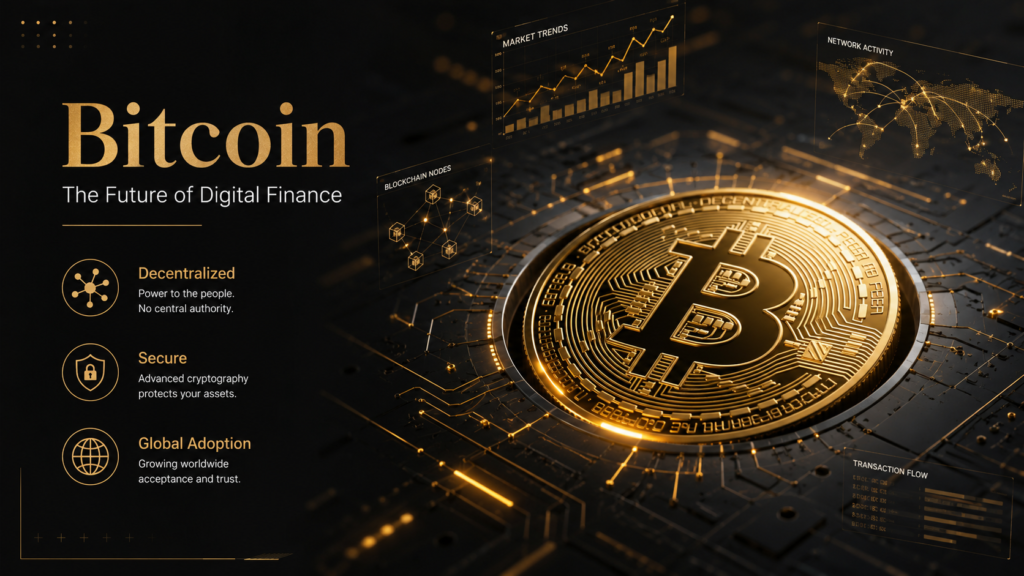
The Future of Bitcoin
Bitcoin’s future appears promising, with several key trends shaping its trajectory:
- Institutional Adoption: More financial institutions are likely to offer Bitcoin investment products.
- Integration into Financial Services: Banks and payment providers may increasingly integrate Bitcoin into mainstream services.
- Technological Advancement: Continued innovation in blockchain, scalability, and security will enhance usability.
- Global Recognition: As more countries adopt or regulate Bitcoin, its legitimacy as a global currency could increase.
Experts predict that Bitcoin will continue to play a central role in digital finance, serving both as a store of value and a medium of exchange in a rapidly evolving global economy.
Conclusion
Bitcoin has emerged as a revolutionary force in the financial world. From its origins as a decentralized digital currency to its adoption by investors, businesses, and governments, Bitcoin represents a new paradigm in money and technology.
Its journey illustrates the transformative power of decentralized finance, offering opportunities for financial inclusion, investment diversification, and technological innovation. While challenges remain, the continued growth of Bitcoin infrastructure and adoption demonstrates its resilience and enduring relevance.
As the digital age unfolds, Bitcoin is likely to remain at the forefront of financial innovation, shaping the way we think about money, value, and trust.
FAQ Section for Rich Snippets
FAQ 1: What is Bitcoin?
- Bitcoin is a decentralized digital currency that allows secure peer-to-peer transactions without intermediaries.
FAQ 2: How does Bitcoin work?
- Bitcoin operates on a blockchain, a decentralized ledger that records all transactions, validated through mining.
FAQ 3: Is Bitcoin safe to invest in?
- While volatile, Bitcoin has gained legitimacy as a store of value and investment option, attracting institutional investors.
FAQ 4: Who created Bitcoin?
- Bitcoin was introduced in 2008 by the pseudonymous Satoshi Nakamoto.
FAQ 5: Can Bitcoin be used for everyday transactions?
- Yes, Bitcoin can be used for payments, though adoption and transaction speed vary depending on network and service providers.