
Introduction
Every business faces risk. A customer may slip inside a shop, a contractor may accidentally damage a client’s property, or a company’s advertisement may create a legal complaint. These situations can lead to expensive claims, legal fees, medical bills, settlements, and financial stress. This is where general liability becomes important.
In finance and business protection, general liability usually refers to general liability insurance. It is a common type of business insurance designed to help protect companies from certain third-party claims. These claims may include bodily injury, property damage, personal injury, and advertising injury. For small businesses, startups, contractors, consultants, retailers, service providers, and many other companies, general liability coverage can be a basic part of risk management.
A business may be profitable, growing, and trusted by customers, but one unexpected claim can create serious financial pressure. Without protection, the business owner may need to pay legal defense costs, medical expenses, or damage claims from business funds. That can affect cash flow, savings, growth plans, and long-term stability.
This article explains what general liability means, how it works, what it covers, what it does not cover, why businesses need it, and how to choose the right coverage. The goal is to make the topic simple, useful, and easy to understand for beginners, business owners, finance readers, and anyone learning about business insurance.
What Is General Liability?
General liability is a type of financial protection that helps a business handle certain claims made by third parties. A third party means someone outside the business, such as a customer, visitor, client, vendor, landlord, or another company.
In most cases, when people say general liability, they are talking about general liability insurance. This coverage can help pay for legal defense, settlements, medical expenses, or property damage claims if the business is found responsible for a covered incident.
For example, if a customer visits a store and falls because of a wet floor, the customer may claim that the business was responsible. If the claim is covered, general liability insurance may help with medical bills or legal costs. Another example is a contractor accidentally damaging a client’s wall while working. General liability may help cover that property damage claim.
General liability is not the same as full business insurance. It does not cover every risk. It usually does not cover employee injuries, professional mistakes, business vehicle accidents, cyberattacks, or damage to the business’s own property. Those risks often need separate policies.
In simple words, general liability helps protect a business from common third-party claims that could otherwise become expensive.
Why Is General Liability Important in Finance?
From a finance point of view, general liability is important because it protects business cash flow and reduces unexpected financial exposure. Business owners work hard to earn revenue, manage expenses, and build profit. A single claim can disturb that balance.
Legal costs can be expensive even if a business did not intentionally do anything wrong. A lawsuit may require attorney fees, court costs, investigation costs, and settlement negotiations. Without insurance, these costs may come directly from the company’s bank account.
General liability also supports financial planning. When a business has insurance, it can better estimate risk and avoid sudden large losses. This makes budgeting more stable.
Another financial benefit is contract compliance. Many landlords, clients, vendors, and project owners require proof of general liability insurance before doing business. Without it, a company may lose contracts or rental opportunities.
For small businesses, this coverage can be especially important because they may not have large emergency funds. A claim that is manageable for a big corporation can be very difficult for a small business.
General liability is not only an insurance product. It is a financial risk management tool.
What Does General Liability Insurance Cover?
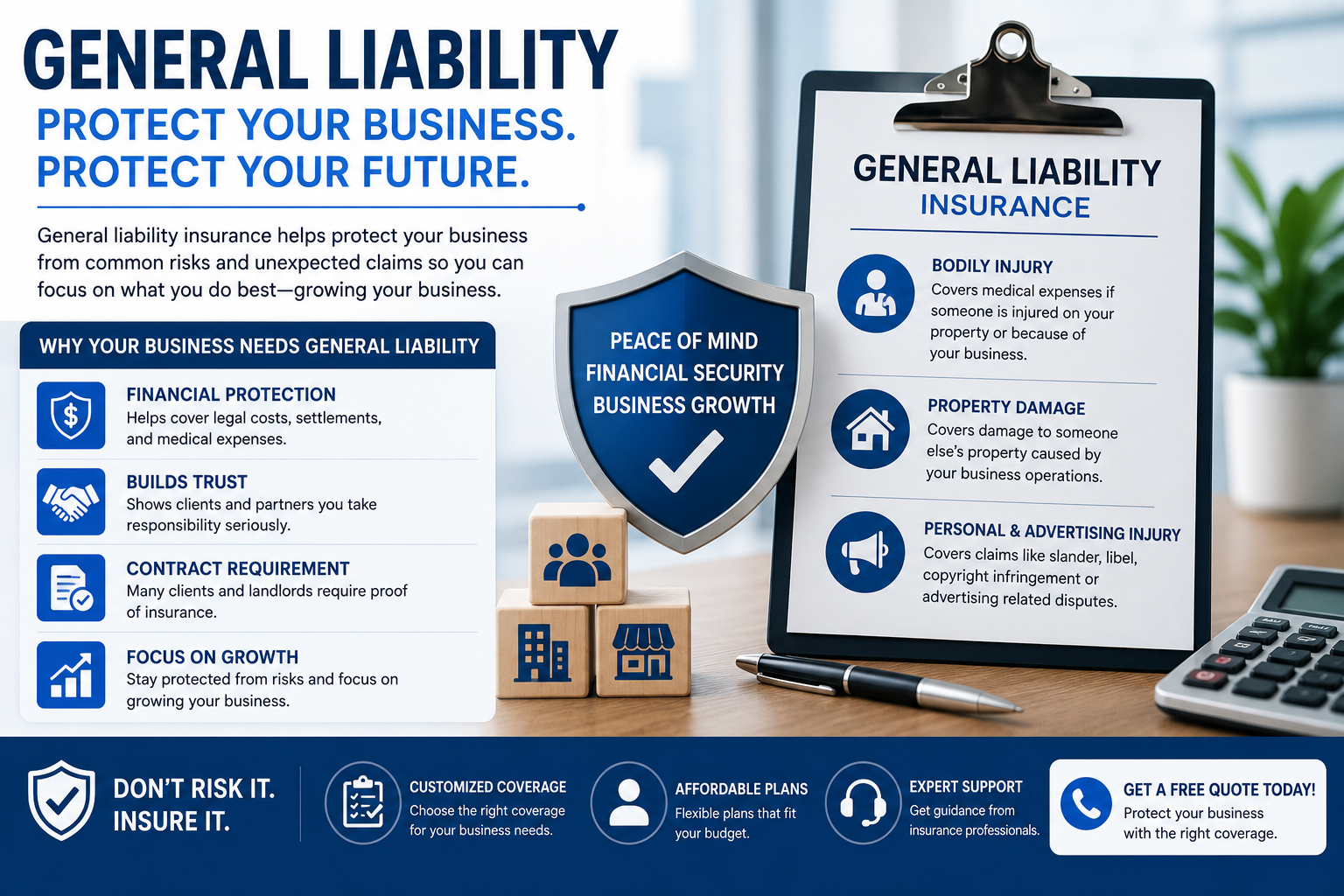
General liability insurance usually covers several common business risks. The exact coverage depends on the policy, insurer, industry, and location, but many policies focus on third-party bodily injury, third-party property damage, personal injury, and advertising injury.
Bodily injury coverage may apply if someone is physically hurt because of a covered business-related incident. For example, a customer may slip and fall inside a store or office.
Property damage coverage may apply if the business damages someone else’s property. For example, a cleaning company may accidentally damage a client’s expensive furniture.
Personal injury coverage may include certain non-physical harms, such as claims related to slander, libel, or wrongful statements, depending on the policy.
Advertising injury coverage may involve claims related to advertising, marketing, or promotional content. This can include certain claims connected to misleading advertising, copyright issues in ads, or reputation harm, depending on policy language.
General liability may also cover legal defense costs for covered claims. This can be one of the most valuable parts of the policy because legal defense can be expensive.
However, coverage always depends on the policy terms. A business should read the policy carefully and ask the insurance provider about unclear areas.
What Is Not Covered by General Liability?
A common mistake is thinking that general liability covers every business problem. It does not. General liability is useful, but it has limits and exclusions.
It usually does not cover employee injuries. Employee injury claims are typically handled by workers’ compensation insurance.
It usually does not cover professional mistakes. If a consultant, accountant, designer, marketer, or advisor makes a professional error that causes financial loss to a client, professional liability or errors and omissions insurance may be needed.
It usually does not cover business vehicle accidents. Commercial auto insurance is normally required for vehicles used for business purposes.
It usually does not cover cyber risks. Data breaches, hacking, ransomware, and digital privacy issues usually require cyber liability insurance.
It usually does not cover damage to the business’s own property. Commercial property insurance or a business owner’s policy may be needed for that.
It usually does not cover intentional harm or illegal acts. Insurance is designed for accidental or covered risks, not intentional wrongdoing.
Because exclusions can vary, every business should review its policy carefully. Understanding what is not covered is just as important as knowing what is covered.
Who Needs General Liability Insurance?
Many businesses can benefit from general liability insurance. It is commonly used by small businesses, contractors, retail stores, restaurants, consultants, cleaning companies, construction businesses, marketing agencies, event businesses, freelancers, and service providers.
A business may need general liability if customers visit its location. For example, shops, salons, clinics, offices, and restaurants have foot traffic. More visitors can mean more chances of accidents.
A business may also need it if it works at client locations. Contractors, repair companies, installers, cleaners, and maintenance teams may accidentally damage client property.
A company that advertises services may need it because marketing and communication can create advertising injury claims.
Landlords may require tenants to carry general liability insurance before signing a commercial lease. Clients may also require it before awarding contracts.
Even online businesses may need general liability in some cases, especially if they sell products, work with vendors, or have business relationships that require proof of insurance.
The need depends on business type, risk level, contracts, state rules, and customer exposure.
How Does General Liability Protect Small Businesses?
Small businesses often operate with limited cash reserves. One unexpected lawsuit or claim can create serious financial difficulty. General liability helps protect small businesses by reducing the direct financial impact of covered third-party claims.
For example, a small bakery may face a claim if a customer slips near the entrance. A small contractor may face a claim after damaging a client’s property. A small marketing agency may face an advertising-related complaint. In each case, general liability insurance may help with covered costs.
This protection can help business owners stay focused on operations instead of worrying about every possible accident. It also makes the business look more professional. Clients often feel more comfortable working with insured businesses.
General liability can also help small businesses qualify for contracts. Many companies do not hire vendors unless they provide a certificate of insurance.
In short, general liability helps small businesses protect money, reputation, and business continuity.
How Much Does General Liability Cost?
The cost of general liability insurance depends on several factors. There is no single fixed price for every business. Insurance companies look at the risk level of the business before setting the premium.
One major factor is business type. A construction company usually has higher risk than a small office-based consulting business. Higher risk often means higher premiums.
Another factor is business size. Revenue, payroll, number of employees, and customer traffic can affect cost. A larger business may face more exposure than a smaller one.
Location also matters. Insurance costs can vary by state, city, legal environment, and local claim trends.
Coverage limits affect price too. A policy with higher limits usually costs more than a policy with lower limits.
Claims history is another factor. A business with past claims may pay more than a business with a clean record.
Operations also matter. If a business works at client sites, handles physical products, uses subcontractors, or has public foot traffic, the risk may be different.
The best way to know the cost is to compare quotes from licensed insurance providers.
What Are General Liability Coverage Limits?
Coverage limits are the maximum amounts an insurance policy may pay for covered claims. In general liability insurance, two common limits are per-occurrence limit and aggregate limit.
The per-occurrence limit is the maximum amount the policy may pay for one covered incident. For example, if the per-occurrence limit is $1 million, that is the maximum available for a single covered claim, depending on policy terms.
The aggregate limit is the maximum amount the policy may pay during the policy period, usually one year. For example, a policy may have a $2 million aggregate limit. This means the total paid for all covered claims during the policy year cannot exceed that amount.
Businesses should choose limits based on risk, contract requirements, industry standards, and financial exposure. A small low-risk business may need different limits than a construction company or manufacturer.
Sometimes clients or landlords specify minimum coverage limits in contracts. Businesses should always review contract insurance requirements before buying a policy.
Choosing limits is a financial decision. Too little coverage may leave the business exposed, while too much coverage may increase costs unnecessarily.
General Liability vs Professional Liability
Many people confuse general liability with professional liability, but they are not the same.
General liability usually covers third-party bodily injury, property damage, and certain personal or advertising injury claims. It is more about accidents and general business risks.
Professional liability, also known as errors and omissions insurance, usually covers claims related to professional mistakes, negligence, or failure to provide promised services. It is especially important for consultants, accountants, designers, agencies, real estate professionals, IT service providers, and other experts.
For example, if a customer slips in your office, general liability may apply. But if a client claims that your professional advice caused them financial loss, professional liability may be needed.
Some businesses need both policies. A marketing agency may need general liability for office-related risks and professional liability for service-related mistakes. A contractor may need general liability for property damage and professional liability for design or consulting errors.
Understanding the difference helps businesses avoid dangerous coverage gaps.
General Liability vs Business Owner’s Policy
A business owner’s policy, often called a BOP, combines different types of coverage into one package. It commonly includes general liability and commercial property insurance. Some BOPs may also include business interruption coverage.
General liability by itself focuses mainly on third-party claims. It does not usually cover damage to the business’s own building, equipment, inventory, or furniture.
A BOP may be useful for small and medium-sized businesses that need both liability and property protection. For example, a retail shop may want general liability for customer injuries and property coverage for inventory and equipment.
However, not every business qualifies for a BOP. Some higher-risk businesses may need customized insurance.
The choice between general liability and a BOP depends on what the business needs. If the business only needs third-party liability protection, general liability may be enough. If it also needs property protection, a BOP may be better.
Business owners should compare both options carefully before deciding.
General Liability vs Workers’ Compensation
General liability and workers’ compensation cover different types of claims.
General liability covers certain claims made by third parties, such as customers, visitors, vendors, or clients. Workers’ compensation covers employees who are injured or become ill because of work-related duties.
For example, if a customer slips in your store, general liability may apply. If an employee slips while working in the store, workers’ compensation may apply.
Many states require businesses with employees to carry workers’ compensation insurance. General liability does not replace workers’ compensation.
This difference is very important. A business owner may think they are protected because they have general liability, but employee injuries usually need separate coverage.
Businesses with employees should check their state requirements and speak with an insurance professional.
General Liability and Contracts
Contracts are one of the main reasons businesses buy general liability insurance. Many clients, landlords, project owners, and vendors require proof of coverage before working with a company.
A commercial lease may require the tenant to carry general liability insurance. This protects the landlord if a claim happens connected to the tenant’s operations.
A client may require a contractor to show proof of insurance before starting work. This protects the client from financial risk if property damage or injury occurs during the project.
Sometimes contracts also require the business to add another party as an additional insured. This means the other party may receive certain protection under the policy for specific situations.
Businesses should not ignore insurance requirements in contracts. Failing to carry required coverage can lead to contract problems, lost opportunities, or personal financial exposure.
Before signing a contract, business owners should read the insurance section carefully and confirm that their policy meets the requirement.
What Is a Certificate of Insurance?
A certificate of insurance, often called a COI, is a document that proves a business has insurance coverage. It usually shows the policy type, coverage limits, insurance company, policy dates, and insured business name.
For general liability, a COI may be required by clients, landlords, event organizers, or vendors. It is not the full insurance policy, but it provides a summary of coverage.
For example, a contractor may need to send a COI to a client before starting work. A business renting office space may need to provide a COI to the landlord. An event vendor may need one before setting up at a venue.
A COI helps build trust because it shows that the business has financial protection in place. However, a COI should match the actual policy. Businesses should make sure all details are correct.
If a client asks for additional insured status, the business should confirm with the insurance provider before agreeing.
How to Choose General Liability Insurance
Choosing general liability insurance requires careful review. The cheapest policy is not always the best. Business owners should focus on coverage quality, limits, exclusions, insurer reputation, and claims support.
First, understand your business risks. A low-risk online consultant has different needs than a construction contractor or retail store.
Second, check client and lease requirements. If contracts require specific coverage limits, your policy must match them.
Third, compare coverage limits. Make sure the per-occurrence and aggregate limits are enough for your risk level.
Fourth, review exclusions. Some policies exclude certain operations, products, locations, or activities.
Fifth, check whether you need additional insured endorsements. This matters for contractors, vendors, landlords, and project-based work.
Sixth, compare quotes from multiple providers. Prices can vary.
Seventh, ask questions. A good insurance agent or broker should explain coverage in simple terms.
Finally, review the policy every year. As your business grows, your coverage may need to change.
Common Mistakes Businesses Make
One common mistake is buying coverage without understanding it. Business owners may see “general liability” and assume everything is covered. This can create problems later.
Another mistake is choosing limits that are too low. If a claim is larger than the policy limit, the business may need to pay the difference.
A third mistake is ignoring exclusions. Some businesses discover too late that a specific activity is not covered.
A fourth mistake is not updating the policy when the business changes. New services, employees, locations, or products can change risk.
A fifth mistake is not checking contract requirements. A client may require higher limits or additional insured status.
A sixth mistake is confusing general liability with professional liability. Service businesses may need both.
A seventh mistake is not keeping proof of insurance ready. Delays in sending a COI can slow down deals and contracts.
Avoiding these mistakes can help businesses stay better protected.
How General Liability Supports Business Growth
General liability can support business growth by increasing trust and reducing financial uncertainty. When clients know a business is insured, they may feel more confident working with it.
Insurance can also help businesses win contracts. Many larger clients do not work with uninsured vendors. Having general liability coverage can open doors to better opportunities.
It also allows business owners to operate with more confidence. While insurance does not remove all risk, it provides a financial safety layer.
General liability may also protect the business reputation. If a claim happens, the insurer may help manage the legal and financial process. This can reduce stress and help the business continue operating.
For growing companies, insurance should be part of financial planning. As revenue increases, risks can increase too. More customers, bigger contracts, and larger operations may require stronger protection.
In this way, general liability is not only defensive. It can also support professional growth.
General Liability for Online Businesses
Online businesses may think they do not need general liability, but that is not always true. Even if a business operates online, it may still face third-party claims.
For example, an online seller may face claims related to a product. A digital business may rent office space or attend events. A consultant may meet clients in person. A marketing company may face advertising injury claims.
Online businesses may also need professional liability or cyber insurance, depending on their services. General liability does not usually cover cyber incidents or professional errors.
A home-based business should also check coverage. Homeowners insurance may not cover business activities. A separate business policy may be needed.
The right coverage depends on how the online business operates, what it sells, where it works, and what risks it faces.
General Liability for Contractors
Contractors often need general liability because they work at client locations and may face property damage or injury claims. Construction, painting, plumbing, electrical work, cleaning, repairs, landscaping, and installation services all involve physical risk.
A contractor may accidentally damage a wall, floor, pipe, window, or furniture. A client or visitor may get injured near the worksite. Tools or materials may create hazards.
Many clients require contractors to provide proof of general liability before work begins. Some states, cities, or licensing boards may also have insurance requirements.
Contractors should also understand subcontractor risk. If subcontractors work on a project, the contractor should confirm whether they carry their own insurance.
General liability is one of the most important policies for contractors, but it may not be enough alone. Commercial auto, workers’ compensation, tools coverage, and professional liability may also be needed.
General Liability for Retail and Service Businesses
Retail and service businesses often interact with customers directly. This makes general liability important.
A retail store may face slip-and-fall claims. A salon may face customer injury claims. A restaurant may face customer accident claims. A fitness studio may face injury-related claims. A repair shop may face property damage claims.
Customer-facing businesses should pay attention to safety. Clean floors, clear walkways, proper lighting, warning signs, staff training, and regular inspections can reduce risk.
Insurance helps after a covered claim, but prevention is still important. Fewer accidents can mean fewer claims and better long-term insurance costs.
Retail and service businesses should also consider product liability, commercial property insurance, workers’ compensation, and business interruption coverage depending on their needs.
Risk Management Tips for Businesses
Insurance is important, but risk management is also necessary. Businesses should not rely only on general liability coverage. They should also reduce the chance of claims.
Keep business premises clean and safe. Remove hazards quickly. Use warning signs when floors are wet. Maintain equipment. Train employees. Keep proper records.
Use written contracts. Clear agreements can reduce misunderstandings with clients and vendors.
Document work. Contractors and service providers should take before-and-after photos when appropriate.
Follow safety rules. Industry standards and local regulations matter.
Review advertising carefully. Avoid misleading claims, unauthorized images, or statements that could create legal problems.
Keep communication professional. Avoid statements that could be considered harmful or false.
Update insurance when business operations change.
Good risk management protects money, reputation, employees, and customers.
FAQs About General Liability
1. What is general liability?
General liability usually refers to insurance that helps protect a business from certain third-party claims, such as bodily injury, property damage, personal injury, and advertising injury.
2. Why do businesses need general liability insurance?
Businesses need general liability insurance to protect against common claims that may lead to legal costs, medical expenses, settlements, or financial loss.
3. What does general liability cover?
It may cover third-party bodily injury, third-party property damage, personal injury, advertising injury, and legal defense costs for covered claims.
4. What does general liability not cover?
It usually does not cover employee injuries, professional mistakes, business vehicle accidents, cyberattacks, intentional harm, or damage to the business’s own property.
5. Is general liability required by law?
It depends on the business, industry, location, and contracts. Even when not legally required, landlords or clients may require it.
6. How much general liability insurance do I need?
The right amount depends on your business risk, contracts, industry, revenue, customer exposure, and financial protection needs.
7. Is general liability the same as professional liability?
No. General liability covers common third-party injury and property claims, while professional liability covers service mistakes, errors, or negligence claims.
8. Is general liability included in a business owner’s policy?
A business owner’s policy often includes general liability plus commercial property coverage, but exact coverage depends on the policy.
9. Can online businesses need general liability?
Yes. Online businesses may need general liability if they sell products, meet clients, rent space, attend events, or face advertising injury risks.
10. How can I lower general liability risks?
You can lower risks by keeping safe premises, training employees, using written contracts, reviewing advertising, documenting work, and following safety practices.
Conclusion
General liability is one of the most important finance and insurance topics for businesses. It helps protect companies from common third-party claims involving bodily injury, property damage, personal injury, and advertising injury. For many businesses, it is a basic part of financial protection and risk management.
A single claim can create legal costs, medical bills, settlements, and stress. General liability insurance may help reduce that financial burden. It can also help businesses meet contract requirements, build trust with clients, and operate more professionally.
However, general liability does not cover every risk. Businesses may also need workers’ compensation, professional liability, cyber insurance, commercial auto insurance, or property coverage depending on their operations.
The best approach is to understand your business risks, review policy terms carefully, compare coverage options, and update your insurance as your business grows. A strong general liability plan can protect your business, support financial stability, and give you more confidence in daily operations.
Canva Search Suggestion: Business Insurance
Image Keyword: General Liability