
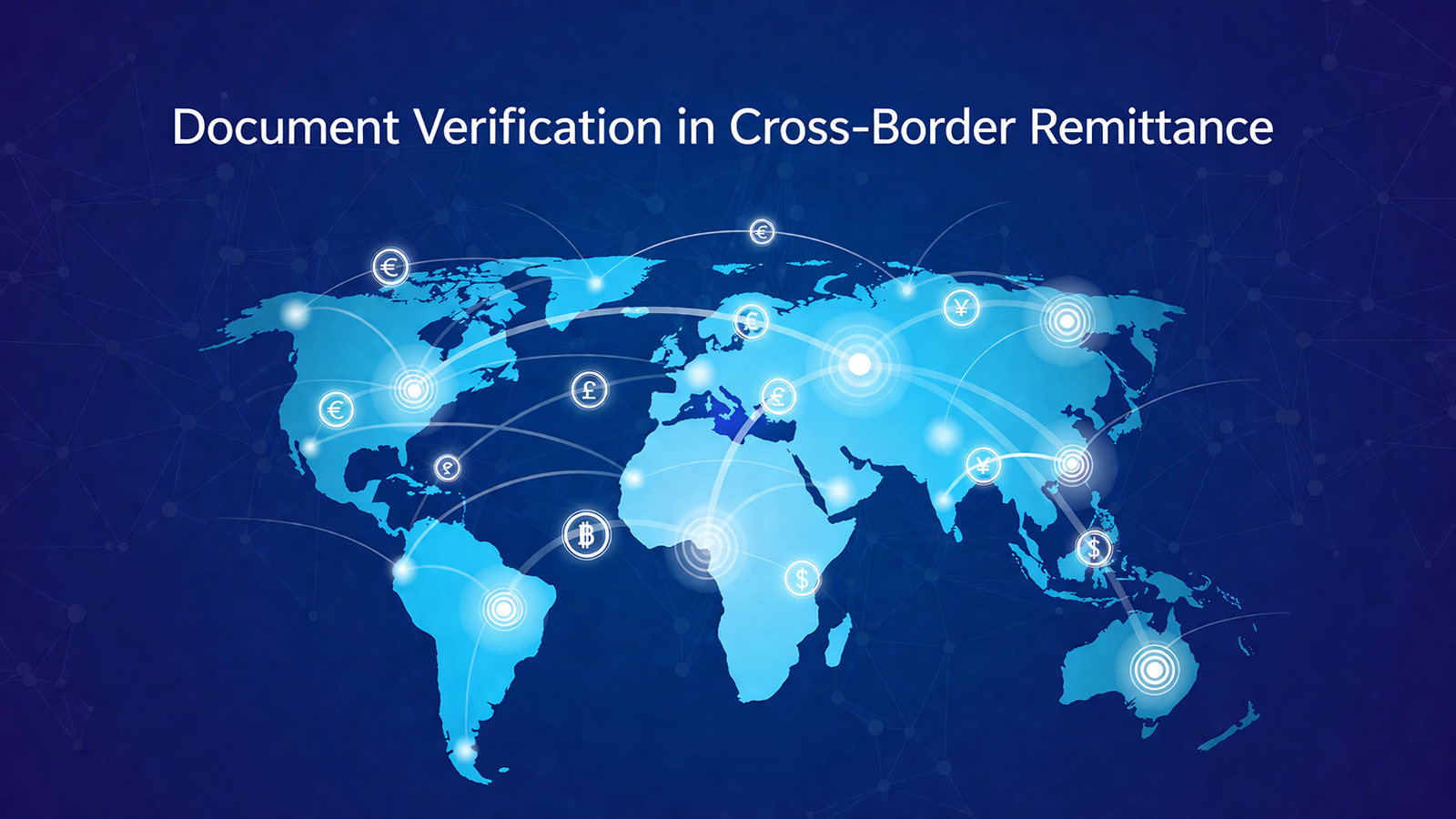
The world remittance market has a value of about 905 billion. More than 771 million individuals had cross-border transactions between June 2023 and June 2024 alone (Visa Direct, 2024). A lot of money crossing the border- and a lot of identity documents being inspected in between.
But Document Verification cross-border payments fraud is picking up. According to a recent survey by J.P. Morgan, 88% of surveyed individuals reported an instance of payment fraud in 20222023. More telling: 4 out of every 10 consumers already are more likely to be a victim of a cross-border transfer compared to a domestic transfer (Mastercard Borderless Payments Report, 2024).
It is not the amount of checks that is being performed. The quality checked is the quality of what is being checked.
Why Remittance Platforms Are a Favourite Target
International money transfer is the only area that is vulnerable to document fraud – not due to the reasons most guides present.
To start with, disparate identity standards in 190+ jurisdictions imply that a money transfer operator who works with migrants residing in Bangladesh, Nigeria, and Mexico all at the same time must deal with dozens of different types of government-issued IDs – various security features, scripts, layouts, and expiry policies. The inability of platforms to process this diversity with reliability results in staff falling back to manual review, which trained fraudsters are well aware of how to cheat.
Second, the speed competition provides perilous pressure. In contrast to banks, most remittance apps attract customers with their ability to onboard a new sender as quickly as possible. The motivational effect of this minimization of friction is to minimize scrutiny – which is actively taken advantage of by fraud networks.
Third, and most importantly, remittance accounts are becoming more and more landing accounts of stolen funds. In November 2024, FinCEN issued a specific alert that fake identity Document Verification generated by AI are being used to open accounts at money services businesses (MSBs), where the accounts are being deposited by compromised sources.
What Document Forgery Actually Looks Like in 2025
Faking of documents ceases to be an art that involves costly machinery. It is currently a $15 online sale.
In 2024, an underground service called OnlyFake was found, which was based on the use of generative AI to create passports and driver’s licences that are photorealistic. The founder asserted that such documents would be able to pass KYC checks on exchanges such as Binance, Kraken, and Revolut. One of these documents was independently tested by 404 Media and it passed the identity verification on OKX.
The magnitude of the fallout is large. In the first half of 2025 alone, US lenders were exposed to suspected synthetic identities to the tune of 3.3 billion (TransUnion). A 2025 Identity Fraud Report released by Sumsub established that 2% of all of the identified counterfeit documents were generated with the help of generative AI tools – this number calculates across a six-month monitoring timeframe. The direction of the movement is very clear.
The Regulatory Exposure Nobody Is Talking About
The weak document checks are not only a risk of fraud. They are a regulatory burden that is continually increasing in price.
As of the first half of 2025, world regulators imposed about 1.23 billion in AML-related fines – a record 417 percent higher than in 2024 (Fenergo). These penalties were mainly linked to customer identity check failures during the onboarding process.
In its latest update, Recommendation 16 (amended in 2025) implements a more stringent verified identity of the originator of cross-border transactions above the relevant limits. Any remittance business that has not yet onboarded remittance platforms and MSBs with document-level verification are directly at risk of being de-risked by correspondent banks – an existential threat.
The question that all compliance teams must be posing is: would you be able to prove to a regulator that you checked the identity documents of your top 100 active senders properly, were you certain that you did?
What Effective Document Verification Actually Requires
To verify documents reliably across remittance corridors, you need more than OCR that reads text off an image.
Coverage that matches your corridors. A reliable document checker must support the specific ID formats from the countries where your senders actually live, not just Western government IDs. High-volume remittance corridors (South Asia to GCC, Philippines to US, West Africa to UK) involve document formats that basic systems reject or misread entirely.
Security feature analysis. OCR extracts data. Real fraud detection goes further by analysing MRZ integrity, hologram patterns, font consistency, UV simulation, and microprinting. These are the checks that catch AI-generated fakes that pass a simple image scan. When you verify documents at this level, synthetic identities have nowhere to hide.
Biometric liveness to close the loop. Confirming that kyc documents are genuine is only half the job. Without biometric liveness tying the document to the physical sender, a “verified” document proves nothing about who is actually initiating the transfer.
Speed that does not compromise accuracy. Remittance senders expect fast onboarding. Effective verification completes all of the above in seconds — not minutes — to prevent the drop-off that drives up acquisition costs.
How Shufti Detects Remittance Operators
The Document Verification Service by Shufti covers more than 10,000 types of documents in 240+ countries and territories in over 150 languages. This is not a fringe benefit to a remittance platform that is involved with migrant populations in South Asia, Sub-Saharan Africa, or Southeast Asia. It implies that you can in fact, verify the IDs presented by your users without either rejecting real senders or clearing fraudulent senders.
The platform has in-house OCR matching or surpassing Google OCR in 6 of 9 tested languages, and security feature analysis and iBeta Level 1 & 2 certified liveness detection. In contrast to platforms that rely on third-party aggregators, Shufti is developed in-house, thus, allowing quicker updates to new document types, ISO 27001:2022 certified data-handling, and no reliance on external data to update or audit.
In cases where compliance teams have to strike a balance between regulatory demands and conversion goals, a no-code Journey Builder can enable individual verification flows to be defined by corridor, by risk level, or by regulatory need, without engineering holds-up.
The Bottom Line
One of the most rapidly developing financial services verticals in the world is remittance. It is also among the most vulnerable to document fraud, not due to a lack of technology to prevent it, but because much of the infrastructure to verify compliance has never been deployed with this issue in mind.
AI is used by fraudsters to take advantage of remittance platforms today. Regulators are fining them for it use data. The answer must be a document verification service that is able to keep up with both.
Our Expert. Is The Best news Finders For All.